01 / THE IDEA
Access to a paper is only
the beginning.
A paper can be freely available and still be difficult to understand. Technical language, unfamiliar methods and conflicting findings make it hard to work out what a study actually tells us—especially outside our own field.
I started What Does Research Say to make that first step easier. The goal is a short, readable explanation with the original evidence close by: what was studied, what was found, where findings differ, and what remains uncertain.
The product should help a reader understand an answer and inspect the sources behind it. That principle connects the interface, the research pipeline and the evaluation work.
02 / THE EXPERIENCE
Three ways to follow
your curiosity.
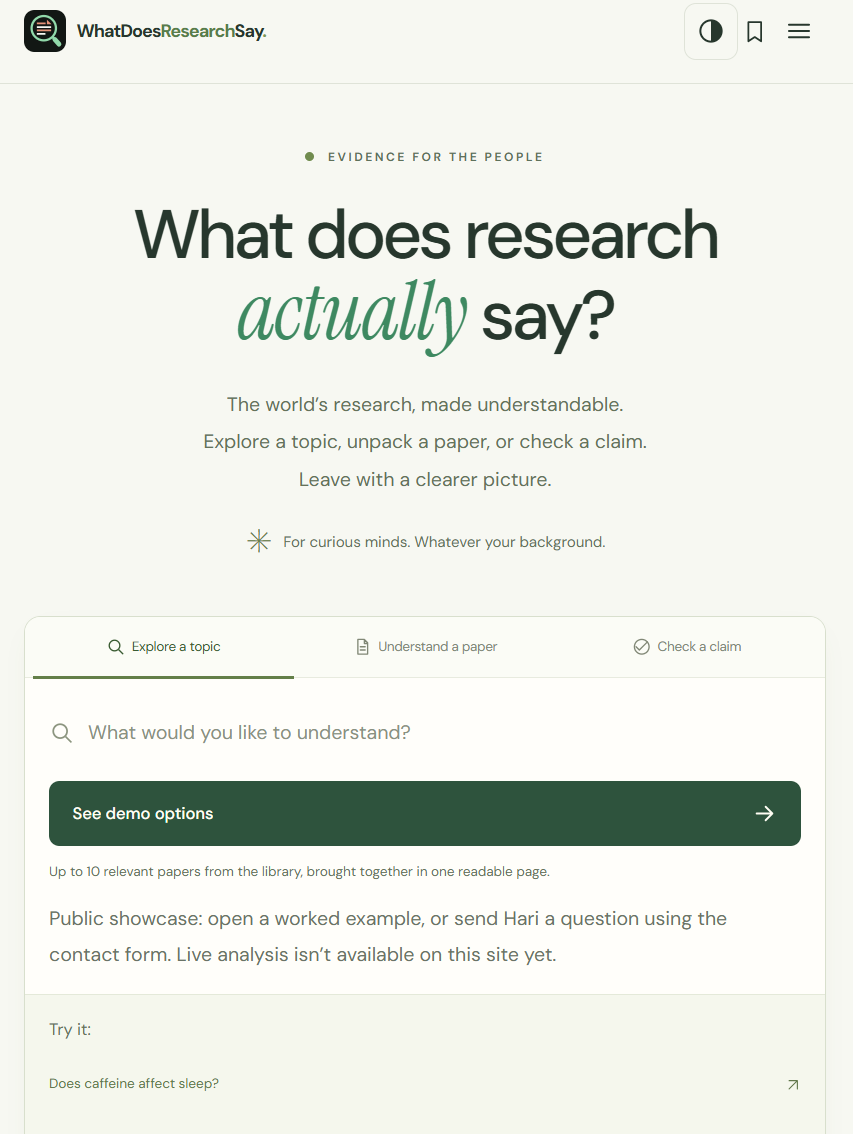
The experience starts with the reader’s question. Each workflow has a different job, while sharing a consistent structure for explanations, sources and limitations.
- 01
Explore a topic
Bring together up to ten relevant papers from the local library. Explain the ideas, compare findings and keep differences in context.
“How does maximum entropy help exploration in reinforcement learning?” - 02
Understand a paper
Start with a selected paper or a PDF. Unpack its question, approach, findings and limitations, with citations restricted to that paper.
“Explain Trust Region Policy Optimization.” - 03
Check a claim
Assess an exact statement against the available research. Keep the qualifications with the verdict, and say when the evidence is insufficient.
“Is this result guaranteed to hold in every setting?”
These describe the intended outputs. All three flows are implemented in the local prototype; reliable generated explanations remain the next quality milestone.
The React interface includes light and dark themes, a searchable library, collection and topic filters, source passages, saved runs and Markdown export. The local version also shows research-job progress and accepts PDF uploads. The public version offers nine prepared examples and the paper catalogue.
03 / THE ENGINEERING
The explanation starts
with the source.
I built a retrieval-augmented generation (RAG) pipeline: find relevant passages first, then give that evidence to a local language model. The work spans document processing, hybrid search, background jobs, model integration and the reading interface.
- 01ImportPDF + XML
- 02RetrieveKeywords + meaning
- 03DraftLocal Qwen model
- 04CheckSources + scope
Output: an explanation with source passages, a partial draft, or an insufficient-evidence response.
- Make the documents traceableParse PDF and full-text XML, retain metadata and page or section references, and split text into overlapping passages. File hashes and source identifiers help prevent duplicate imports.
- Search for words and meaningCombine SQLite FTS5/BM25 keyword search with MiniLM embeddings and cosine similarity. Reciprocal rank fusion combines the result rankings; collection filters and per-paper passage limits keep retrieval bounded.
- Coordinate the work locallyFastAPI manages research jobs while Ollama runs Qwen3.5 on the laptop. Saved results and versioned caches allow earlier runs to reopen without repeating unchanged work. Generation uses no cloud model calls.
- Keep evidence inspectableCopy quotations directly from stored source text. Check citation identifiers, numbers and known scope errors, then apply a model support check. Failed checks can leave a partial result or abstention; they do not guarantee that every remaining statement is correct.
04 / BUILDING THE LIBRARY
A research engine needs
a dependable foundation.
The first local version used eight reinforcement-learning papers. I expanded it to 150 papers across medicine, cancer research and AI, then added 50 papers in each of 20 further fields. The current library contains 1,150 distinct full texts across 23 collections.
The completed audit found no missing originals, duplicate normalised titles, duplicate DOIs or papers without passages. All 127,770 passages had matching search records and embeddings, with no pending indexing work.
Source checking also meant correcting licence metadata and replacing unsuitable documents. The collections remain a selected sample of accessible research. Their publication-volume groupings describe one OpenAlex comparison, rather than a universal ranking of research importance or evidence quality.
Recorded corpus verification: 19 September 2026. These counts describe coverage and indexing, not the accuracy of generated answers.
05 / DEVELOPMENT SO FAR
From an interface
to a working local system.
The reading experience, paper library and local pipeline are built. The current release separates what visitors can explore today from the experimental generation work running locally.
Ready to explore.
Nine prepared, source-linked demos; a searchable catalogue of 1,150 papers; saved examples; light and dark themes; and a contact form.
Open the examplesBuilt for testing.
Full-text ingestion, keyword and semantic retrieval, PDF uploads, generation jobs, source inspection, saved runs and Markdown export.
Fresh analysis runs locally. It is not enabled on the public website.
- Product interface & public demos
- Built
- Library import, indexing & search
- Built
- Local research jobs & source inspection
- Built
- Complete, source-faithful generated answers
- In evaluation
- Public live analysis & user accounts
- Planned
Milestones describe implemented capabilities. Generation quality has separate acceptance criteria.
06 / TESTING THE ANSWERS
A working pipeline is only
part of a useful product.
I compared Qwen3.5 4B and 9B models and read the generated text against its supporting passages. A 4B paper explanation passed length and citation checks while still making an unsupported claim about guaranteed improvement. The same model’s audit accepted it.
The larger model improved some wording but did not resolve the quality problems. The recorded 9B development checks show where the product still falls short:
| Workflow | Observed result | Time |
|---|---|---|
| Topic explanation | Requirement not met249 words; 6 of 10 papers cited. Manual review found unsupported statements. | 641.3 s |
| Single paper | Requirement not met86 words; missing findings and limitations, with an unsupported practical guarantee. | 137.2 s |
| Claim assessment | Requirement not metDeclined to provide a verdict, but gave no usable explanation of the related evidence. | 18.6 s |
| Unrelated question | Expected behaviourCorrectly declined an unsupported question about geology on Neptune. | 2.4 s |
Source: project model-comparison notes. These are individual development cases, not a held-out benchmark or typical response-time estimates.
that the sentence follows.
The next quality milestone is evidence alignment: checking whether each statement is actually supported, preserves the source’s qualifications and makes sense to a reader outside the field.
Long waits on a laptop, incomplete explanations and unsupported claims remain open issues. Tables, figures and equations are also not interpreted reliably. The prototype does not establish scientific consensus or independently verify retractions.
07 / WHAT COMES NEXT
Make the answers earn
the reader’s trust.
This project has brought together product design, document engineering, retrieval and local AI. The most useful lesson so far is that more papers and a larger model do not automatically produce a better explanation. Progress needs to be measured in what readers can understand and verify.
- Build an independent evaluation setUse human-reviewed questions, expected evidence passages and clear criteria for accuracy, completeness and plain-language usefulness.
- Improve evidence selection and repairMatch statements to the passages that support them, preserve qualifications, and repair unsupported drafts instead of simply dropping paragraphs.
- Reduce the waitEvaluate better retrieval and reusable paper notes against the same quality checks, so speed improvements do not come at the expense of fidelity.
- Open fresh analysis when quality is readyMove towards a hosted service with accounts and durable research jobs once measured quality justifies that next release.